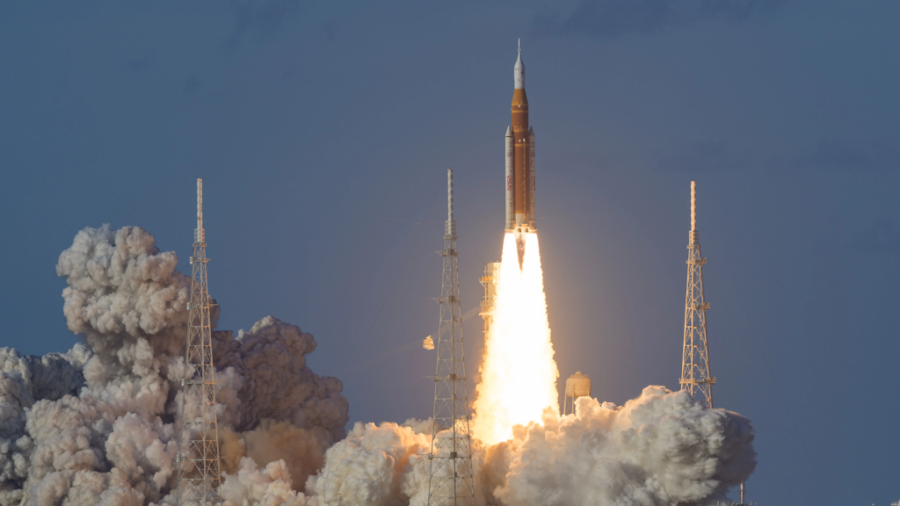
The Artemis II mission marks the first crewed flight beyond low Earth orbit since Apollo 17 in December 1972. It is a ten-day American mission launched on April 1, 2026, from Kennedy Space Center, with a crew consisting of Reid Wiseman, Victor Glover, Christina Koch, and Jeremy Hansen. It is also the second flight of the Space Launch System rocket, the first crewed flight of the Orion spacecraft, and a key preparatory mission for future human landings on the Moon within the Artemis program.
Although Artemis II is often presented primarily as a NASA project, Europe plays a critical operational role. Airbus, on behalf of ESA, produces Orion’s European Service Module, which provides propulsion, electrical power, thermal control, and the air and water necessary for crew survival. Airbus therefore accurately describes it as the “powerhouse” of Orion, as without this module the spacecraft would not be able to complete its journey to the Moon and back.
A historic mission with multiple symbolic milestones
Artemis II is a historic mission with multiple symbolic milestones. Victor Glover became the first person of color to travel beyond low Earth orbit, Christina Koch the first woman on such a mission, Jeremy Hansen the first non-American astronaut to fly beyond low Earth orbit, while Reid Wiseman became the oldest person to do so. At the same time, the mission will set a new record for the number of humans simultaneously in deep space, surpassing Apollo 8, when three astronauts left low Earth orbit.
In terms of objectives, Artemis II is often compared to Apollo 8, the first crewed mission to the Moon in 1968. However, its trajectory is closer to Apollo 13, as it uses a free-return trajectory, allowing the spacecraft to loop around the Moon and naturally return to Earth without entering lunar orbit. NASA states that Artemis II will travel farther from Earth than any previous human mission.
What the mission profile looks like
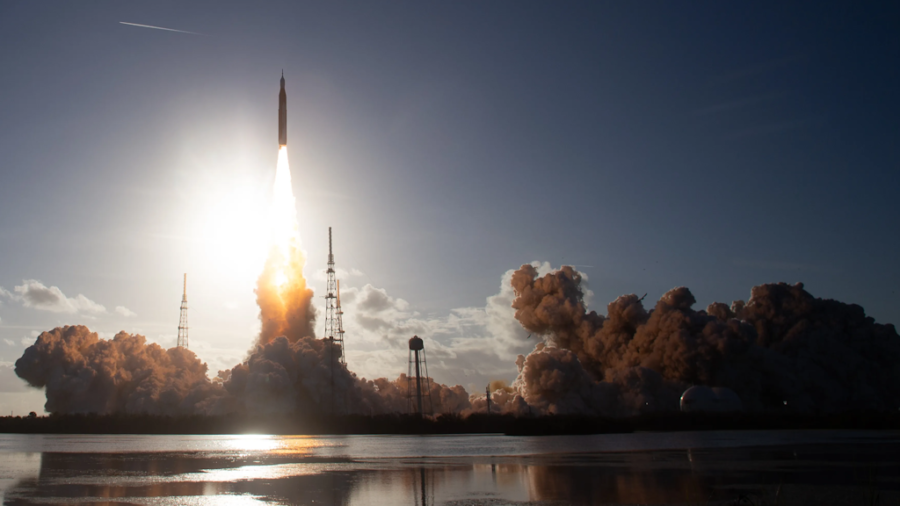
Following launch aboard the SLS Block 1 rocket from Launch Complex 39B, the rocket’s four core engines ignited approximately seven seconds before liftoff, while two solid rocket boosters provided most of the thrust during the first two minutes of flight. Booster separation occurred at around 5,000 kilometers per hour and an altitude of approximately 48 kilometers, while the core stage continued operating for about eight minutes before separation, placing Orion into a highly elliptical Earth orbit with an apogee of around 2,200 kilometers, nearly five times higher than the International Space Station.
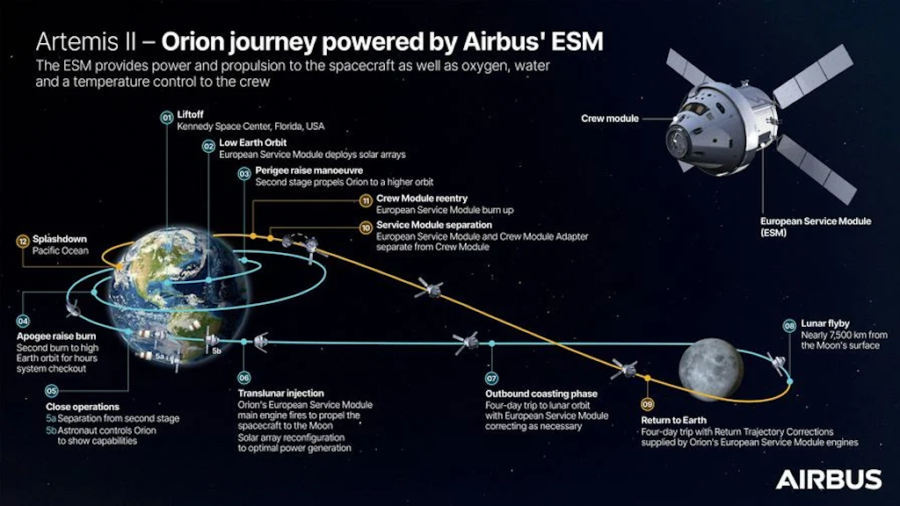
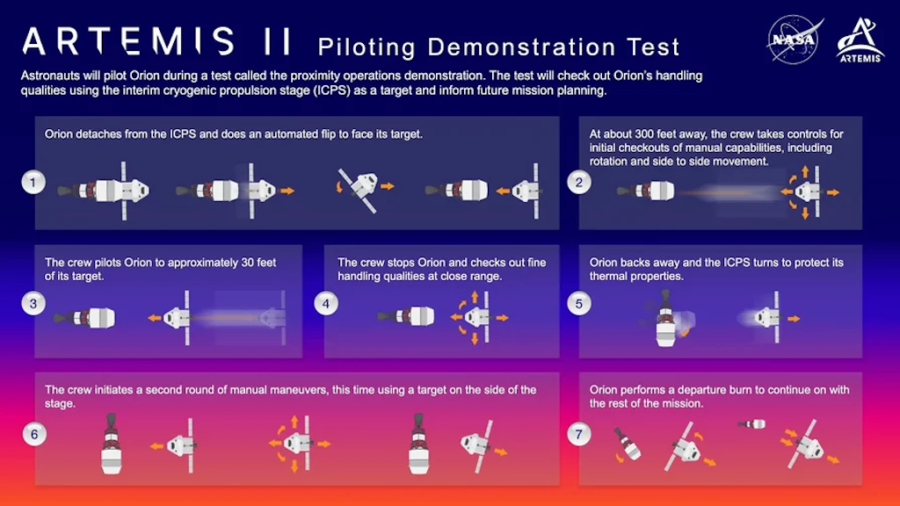
After reaching orbit, system checks began. Immediately after main engine cutoff, the crew started activating and testing critical life-support systems, including water supply, protective equipment, and sanitation systems. The ICPS upper stage then performed a burn to raise perigee, followed by another maneuver placing Orion into a high Earth orbit with a period of about 23.5 hours. During this phase, the crew also conducted proximity operations, maneuvering Orion relative to the spent ICPS stage to evaluate spacecraft handling under manual control.
Only after confirming that all systems were functioning as expected did Orion perform the translunar injection burn, the final major engine firing of the service module that sends the spacecraft toward the Moon. NASA states that this burn lasts 5 minutes and 49 seconds and places Orion on its free-return trajectory.
How close Artemis II will get to the Moon
During its lunar flyby, Orion will pass approximately 6,513 kilometers from the far side of the Moon, while reaching a maximum distance from Earth of about 406,841 kilometers. Some earlier NASA descriptions rounded this figure to roughly 4,700 miles, or about 7,600 kilometers “beyond” the Moon, depending on how the trajectory is defined. It is during this phase that the crew is expected to surpass the distance record previously set by Apollo 13.
This segment of the mission is not only symbolic. During the four-day journey to the Moon and a similar return segment, the crew will collect data on spacecraft behavior in deep space, monitor all key systems, and perform trajectory corrections if necessary. When Orion passes behind the Moon, communication with Earth will be temporarily lost, with NASA expecting about 41 minutes of signal blackout due to the Moon blocking radio transmission.
The European Service Module as the heart of Orion
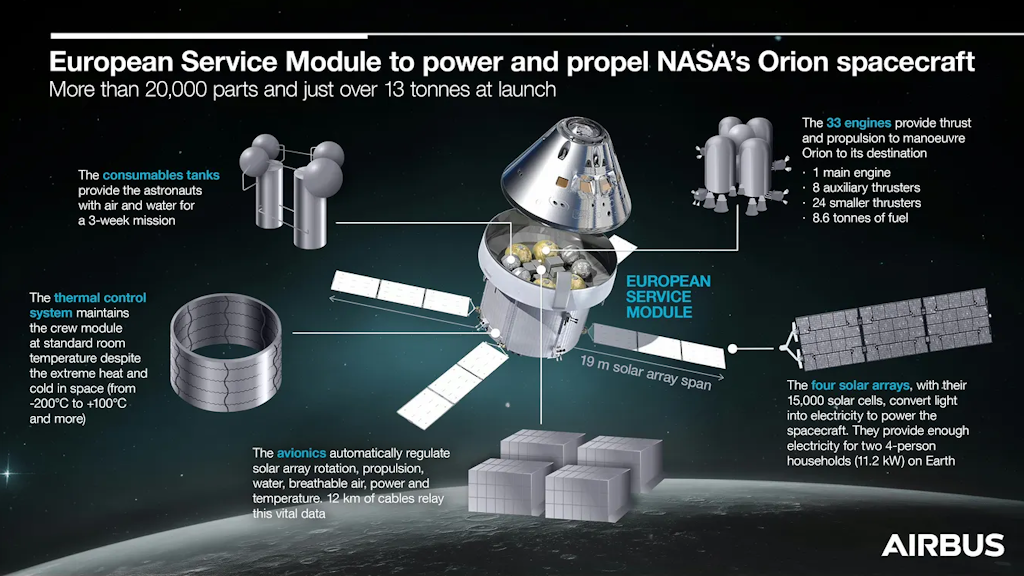
Europe’s role is most visible through the European Service Module 2 (ESM-2). Built by Airbus for ESA, it is a cylindrical module approximately four meters in height and diameter. It houses one main engine, eight auxiliary engines, and 24 smaller thrusters for attitude control, for a total of 33 engines. This system enables all major mission maneuvers, from orbit raising and translunar injection to trajectory corrections and return preparation.
For Artemis II, the ESM is not just a technical demonstrator but an active life-support system. It carries around 90 kilograms of oxygen and 240 kilograms of potable water, which are supplied to the crew module. In addition, its active thermal control system maintains acceptable temperatures inside the spacecraft despite extreme fluctuations in deep space. Electrical power is generated by four large solar arrays producing about 11.2 kilowatts, sufficient for all onboard systems and advanced communication equipment.
Airbus emphasized that the transition from Artemis I to Artemis II represents a shift from a test vehicle to a true living environment. What was tested without humans in 2022 must now function flawlessly with four astronauts onboard, underscoring how critical the European module is not only for mission success but also for crew safety.
Laser communications and manual control
One of the most technically interesting aspects of the mission is the Orion Artemis II Optical Communications System (O2O), a laser communication system integrated into Orion. It includes an optical module with a four-inch telescope, dual gimbals, a modem, and control electronics. The system will communicate with ground stations in California and New Mexico, achieving downlink speeds of up to 260 megabits per second, enabling high-resolution video and image transmission at significantly higher rates than traditional radio systems.
Another key element is the demonstration of manual control during operations in Earth orbit. Victor Glover was tasked with taking primary control and executing a series of maneuvers relative to the ICPS stage to assess Orion’s flight characteristics. This will test how the 13-ton service module behaves under direct human control, an important step toward more complex future lunar operations.
Return to Earth and the heat shield
The return phase of Artemis II will be just as demanding as the journey outward. Orion will re-enter Earth’s atmosphere at around 40,000 kilometers per hour, which NASA describes as the fastest crewed atmospheric entry ever attempted. A skip reentry profile was initially planned, but due to heat shield erosion observed after Artemis I, NASA opted for a steeper reentry trajectory.
The issue with the heat shield involved unexpected loss of parts of the AVCOAT material’s charred layer, caused by trapped gases leading to cracking and localized material loss. Instead of replacing the shield for Artemis II, NASA adjusted the reentry profile to reduce exposure to the conditions that caused the damage. The agency states that additional modeling and testing confirm this approach remains within safety margins, although some former engineers and astronauts have publicly expressed concerns.
Splashdown is planned in the Pacific Ocean near San Diego, where the crew and capsule will be recovered by the U.S. Navy. After extraction, the astronauts will undergo medical checks and further evaluation of physiological adaptation following deep-space travel.
Scientific and medical objectives
Beyond technical validation, Artemis II also has significant scientific and medical objectives. NASA will test AVATAR, an experimental system that mimics human organ responses, for the first time beyond the Van Allen radiation belts. The ARCHAR research program will monitor crew movement and sleep patterns before, during, and after the mission to study the effects of deep space on human health, behavior, and readiness.
Saliva samples will also be collected before, during, and after the flight to track immune biomarkers and assess the impact of radiation, isolation, and distance from Earth on the human body. These data are critical not only for future lunar missions but also for long-term plans for human missions to Mars.
The broader international context
Artemis II also has a strong international dimension. In addition to the Canadian astronaut on the main crew, NASA announced five CubeSat satellites from international partners, including Germany, Argentina, South Korea, and Saudi Arabia. This further reinforces Artemis as a global platform rather than a purely American project.
In this context, Europe is not merely a symbolic participant but a provider of one of the most critical hardware elements of the entire system. Airbus and ESA are already working on future modules. ESM-3 is planned for 2027, ESM-4 is in final integration for Artemis IV, while ESM-5 and ESM-6 are under production in Bremen. This ensures Europe remains an integral part of the United States’ return to the Moon.
Why Artemis II matters for Europe as well
Artemis II is not just another space mission but a real transition from testing to operational use of systems that will carry humans far beyond Earth. For Europe, it demonstrates that its industry and institutions are no longer just supporting partners but equal participants in the most complex missions of modern space exploration. When Orion leaves Earth orbit, its propulsion, power, water, oxygen, and thermal stability will largely depend on the European-built module developed under ESA and Airbus leadership.
That is why Artemis II can justifiably be seen as a European mission as well, at least in technological terms. This time, humanity’s return toward the Moon is not possible without Europe, and that is precisely what makes this mission so important from both a European industrial perspective and the broader future of international deep-space exploration.
Why humanity goes to space at all
In the context of Artemis II, a broader question naturally arises: why do we invest vast resources, knowledge, and decades of development into missions to the Moon and beyond? The answer mirrors the reasons humanity has explored oceans, mountains, polar regions, and unknown continents throughout history. We explore to better understand the world around us, to discover new opportunities, and to improve our survival and quality of life.
Space exploration is therefore not an end in itself. It is part of the same human drive to discover, understand, and push boundaries. At NASA, this vision is described as a pursuit of answers to some of humanity’s deepest questions: why are we here, how did it all begin, are we alone, and what comes next. Alongside these fundamental questions lies a practical one: how can new knowledge and technologies improve life on Earth.
That is why missions like Artemis II have value far beyond the symbolism of returning to the Moon. Space exploration has long driven technological innovation that later finds applications in everyday life, from medicine and communications to materials science, energy, computing, and safety systems. Technologies developed for human spaceflight create jobs, open entire industrial sectors, and stimulate economic growth, while inspiring a new generation of engineers, scientists, artists, and innovators.
The scientific dimension is equally important. Space exploration enables a deeper understanding of Earth, the solar system, and the universe as a whole. It addresses practical questions, such as developing safer fire protection systems, understanding material behavior in microgravity, and studying the effects of radiation on the human body, while also tackling fundamental questions about the origins of the universe and potential resources beyond Earth.
International cooperation is another key aspect. Space exploration remains one of the few areas where countries, agencies, and industries collaborate over the long term. The International Space Station is the best example of such cooperation, and the Artemis program expands this model by involving an increasing number of partners. In that sense, Artemis II is not only a technological demonstration or preparation for future lunar landings but also proof that space exploration can remain one of humanity’s few truly shared, transnational endeavors.
For all these reasons, Artemis II is important not only as a historic crewed flight toward the Moon. It is also a reminder that space exploration provides a new perspective on our planet, enables scientific discovery, accelerates technological development, and brings nations together around shared goals. Its true value lies not only in humanity’s return to the Moon, but in its long-term potential to make life on Earth better, safer, and more technologically advanced.