


The first Airbus A350F has emerged from the paint shop in Toulouse wearing a special livery that could hardly be more appropriate for its future role. The first flight-test example of the new freighter looks like a giant cardboard box ready for delivery, bringing to life a concept first presented to the public three years ago.
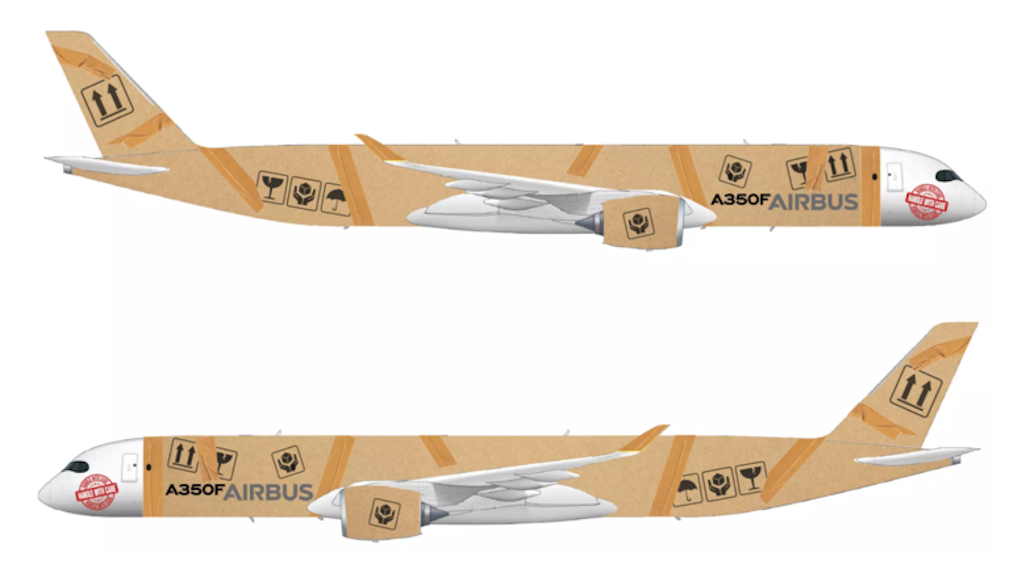
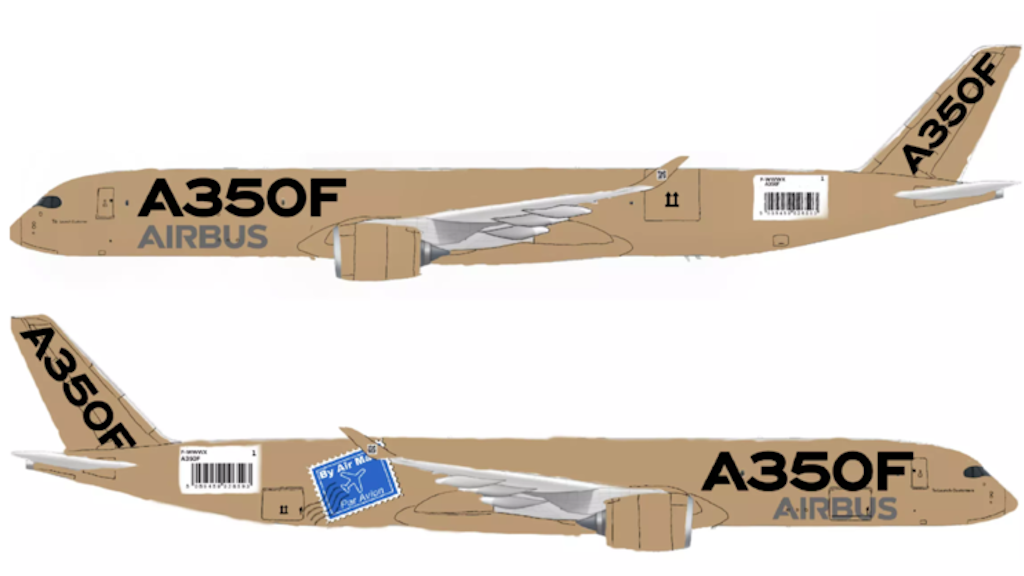
Airbus published the first images of the fully painted aircraft on August 20, describing the reveal as the “ultimate unboxing.” The brown base colour imitates cardboard packaging, while the fuselage features markings typically found on parcels and cargo, including “This Way Up” arrows, various handling symbols, barcodes and orange stripes resembling adhesive tape. The rear section of the fuselage also carries the slogan “Open Here For Business.”
Although the livery has attracted most of the public attention in recent days, the aircraft’s emergence from the paint shop represents a much more important milestone for the programme itself. The aircraft, MSN 700, is the first of two A350Fs intended for the development and flight-test programme, and it has not yet completed its maiden flight.
According to information published by Reuters on August 18, Airbus is currently targeting late September for the first flight, although industry sources have not ruled out a possible delay into early October. The manufacturer has not officially confirmed a specific date, stating only that the maiden flight is planned for 2026.
Livery selected from more than 4,000 entries
The story behind the unusual appearance of the first A350F began in 2022, when Airbus decided to invite the public to help determine the look of its future freighter.
The A350F Livery Design Competition ran from September 12 to November 28, 2022, with participants invited to create a special livery promoting Airbus’ new generation of freighter aircraft. The response was considerable, with more than 4,000 designs submitted from around the world.
The selection process ultimately ended in an unusual way. Among the thousands of entries, the Airbus jury identified two concepts that had independently started from almost exactly the same idea: turning the A350F into a giant parcel ready for delivery. Rather than choosing one over the other, Airbus decided to combine elements of both proposals into the final design.
The joint winners were Irish graphic designer John Feehan and Canadian brothers Quinnten and Ellisten Iversen from Calgary. The winners and the final aircraft design were unveiled on June 21, 2023, during a special ceremony at the Paris Air Show.
The background of the people behind the first A350F’s distinctive appearance is particularly interesting.
John Feehan was 57 at the time and worked as a graphic designer for various clients in the design and printing industries. Based in Dublin, he was actually encouraged to enter the Airbus competition by his son Charlie, who hopes to pursue a career in aviation. Feehan saw the competition as an opportunity to step outside the usual boundaries of his design work and collaborate with one of the world’s largest aircraft manufacturers.
He also has a strong interest in engineering. In his spare time, he is particularly interested in motorcycles, their restoration and engineering, as well as aircraft, trains and cars. His professional experience in graphic design and printing eventually ended up, quite appropriately, on perhaps the largest possible piece of “packaging” – the fuselage of a widebody freighter.
The second winning proposal had an even more unusual story. Quinnten Iversen was 16 and his brother Ellisten only 12 when they won the Airbus competition. Both are from Calgary in the Canadian province of Alberta, and aviation already played a major role in their lives.
Quinnten told Airbus that he had wanted to become a pilot for as long as he could remember. He began flying before obtaining a driving licence and, by the time the winners were presented, was already working towards his private pilot licence and had completed his first solo flight. His younger brother Ellisten attended a school focused on science, while Quinnten had passed on his interest in aviation and his ambition to one day become a pilot as well.
The idea to enter the competition came after Quinnten, while following his daily aviation news, came across Airbus’ announcement. He later explained that the concept suddenly came to him, after which he sat down with his brother and began turning it into an actual design. Ellisten liked the idea of creating something that was both recognisable and different, and joined the project as co-author.
Their interest in aviation went well beyond drawing aircraft. The brothers are plane spotters and model aircraft collectors, while Quinnten is also involved in aviation photography. At the time of the competition, he said he probably owned one of the largest collections of 1:400-scale model aircraft in Canada. In addition to models and spotting, Ellisten is also interested in flight simulation.
The two concepts were created thousands of kilometres apart, yet both viewed the A350F in exactly the same way – as a giant parcel intended to travel from one side of the world to the other. Airbus therefore combined elements of Feehan’s design with those created by the Iversen brothers.
Three years after the competition and the presentation of the original computer renderings, their design has now been applied to an actual A350F for the first time.
Airbus returns to the battle for large freighters
The A350F is one of the most eagerly anticipated new freighter aircraft in decades. Airbus officially launched the programme in 2021, aiming to offer a completely new generation of factory-built widebody freighters in a segment that Boeing has dominated for decades.
The programme is particularly important for Airbus. Its previous purpose-built freighter, the A330-200F, failed to achieve significant commercial success, with Reuters reporting that the aircraft accumulated a total of 38 orders. The A350F has nearly tripled that figure before the first example has even flown.
The timing of its arrival is also no coincidence. A significant proportion of the large freighters currently in service are based on previous-generation aircraft designs, including the Boeing 747-400F and 777F, while operators will increasingly have to plan their replacement over the coming decades.

At the same time, new ICAO CO₂ emissions standards for newly manufactured aircraft will come into effect from 2027. Airbus says the A350F has been designed to comply with the new requirements, giving it an important advantage in the market.
Its main commercial rival will be the Boeing 777-8F, the freighter version of the 777X family. For the first time in decades, Airbus and Boeing are therefore simultaneously developing new factory-built aircraft for the top end of the air cargo market.
Up to 111 tonnes of payload
The A350F draws heavily on technology from the A350-1000, but it is far more than simply a passenger aircraft with the seats removed. Airbus has designed its structure from the outset around the specific requirements of freight transport.
The aircraft will be 70.8 metres long, with a wingspan of 64.8 metres. It will be powered by two Rolls-Royce Trent XWB-97 engines, the same engine type used on the A350-1000.
Maximum structural payload is up to 111 tonnes, while Airbus quotes a range of approximately 4,700 nautical miles. Total capacity amounts to 42 pallet positions.
More than 70 percent of the aircraft’s structure is made from advanced materials, primarily composites and titanium, enabling a significant reduction in weight compared with previous-generation freighters.
One of the most visible structural differences compared with passenger A350s is the large main-deck cargo door positioned on the rear section of the fuselage, behind the wing. Its clear opening measures 4.3 metres wide and 3.15 metres high, making it, according to Airbus, the largest main-deck cargo door in the industry.
Its position behind the wing was not chosen solely because of its dimensions. The arrangement helps manage the aircraft’s centre of gravity during loading and unloading, an especially important consideration when handling cargo weighing tens of tonnes.
Significantly lower fuel consumption than the previous generation
Efficiency is expected to be one of the new Airbus freighter’s strongest selling points. According to Airbus, the A350F should consume approximately 20 percent less fuel and produce around 20 percent fewer CO₂ emissions than the current Boeing 777F.
The comparison with the older Boeing 747-400F is even more substantial. With roughly comparable cargo volume, the A350F is expected to deliver around 40 percent lower fuel consumption and CO₂ emissions.
It is precisely the combination of lower structural weight, modern engines, A350 aerodynamics and a large cargo volume that explains why the new aircraft is being watched so closely by major freight operators.
Already 107 firm orders
The market has responded much more favourably to the A350F than it did to Airbus’ previous attempt with the A330F.
According to the latest available figures, the A350F had accumulated 107 firm orders by the end of July 2026. Reuters confirmed the same figure in a report published on August 18, while Airbus’ latest official orders and deliveries statistics currently cover the period through July 31.
The largest individual customer is currently Atlas Air Worldwide, which has ordered 20 aircraft. Air China Cargo has an order for ten, while Cathay has ordered a total of eight.

Orders have also come from a number of other major airlines, cargo operators and leasing companies, including Singapore Airlines, CMA CGM Air Cargo, Etihad Airways, Korean Air, STARLUX Airlines, Turkish Airlines, Air France, Martinair, MNG Airlines, Silk Way West Airlines and AviLease. Singapore Airlines is expected to become the first operator of the new type.
The fact that more than 100 aircraft have been sold before the A350F’s maiden flight demonstrates the level of market interest in a new generation of large freighters.
Programme running almost two years behind schedule
The path towards the maiden flight, however, has not followed the original schedule. When Airbus launched the programme in 2021, first deliveries and entry into commercial service were planned for 2025. In May 2023, Airbus officially announced for the first time that it was adjusting the industrial schedule and postponing entry into service until 2026.
Another delay followed in early 2025. Airbus announced that entry into service was now expected in the second half of 2027, which remains the current official target for the programme.
Reuters has reported that development in recent months has, among other things, been affected by delays in the production of the large cargo door in Spain. Industry analysts have also warned that first deliveries could slip into 2028, although Airbus has so far maintained its official target of the second half of 2027.
Next stop – maiden flight
Airbus will use two A350Fs, MSN 700 and MSN 701, for the development and certification programme. They are undergoing dozens of specialised tests not required for production aircraft, ranging from structural load testing to evaluation of the cargo-handling systems and the dynamics of the airframe itself.
MSN 700 has now completed another of the most visible stages in its development. After years of computer renderings, production of the first components, final assembly and ground testing, the A350F finally looks like a finished aircraft.
And one that will be rather difficult to confuse with any other A350 on the apron. Airbus has wrapped it like a giant parcel. Now only the most important step remains – sending the “package” into the air.


![[SURVEY] Where would you like to fly with Croatia Airlines in summer 2027?](https://i0.wp.com/avioradar.net/wp-content/uploads/2026/10/CTN_A220-300_9ACAL_c_AvioRadar.jpg?fit=900%2C506&ssl=1)
