

The Ministry of the Sea, Transport and Infrastructure has adopted a new regulation on airport opening hours, defining the minimum operating hours of certified airports in Croatia during the summer flight schedule. The regulation applies to the period from March 29 to October 24, 2026, corresponding to the busiest part of the year for domestic aviation, when most airports record peak traffic levels.
The regulation clearly defines opening hours as the period during which all airport services are operational, including aircraft handling, security procedures, and other essential functions. It applies exclusively to airports holding a valid certificate issued in accordance with European regulations and national legislation. In addition to standard operating hours, the document provides for the possibility of deviations in response to operational needs, allowing airport operators, with Ministry approval, to extend working hours, typically subject to prior notice.
A comparison with last year’s regulation indicates continuity with minor operational adjustments. As before, the timeframe follows the IATA summer season, with slight shifts in the start and end dates compared to 2025.
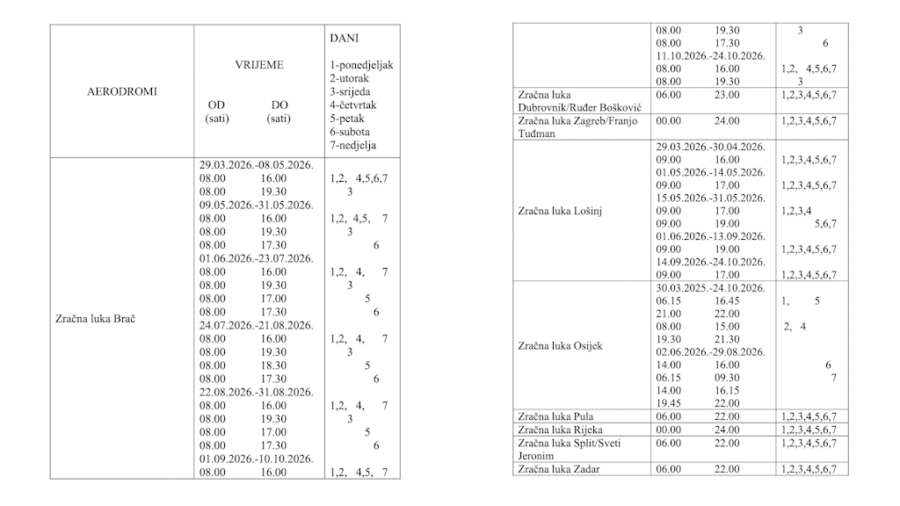
The largest airports continue to maintain stable operating regimes. Zagreb Airport remains open 24 hours a day without changes, while Dubrovnik Airport continues to operate from 06:00 to 23:00 throughout the week. Split Airport, Zadar Airport, and Pula Airport also retain the standard seasonal schedule from 06:00 to 22:00.
The most noticeable changes are observed at smaller and seasonally sensitive airports. Brač Airport continues to have the most detailed schedule, with fine adjustments introduced in certain periods in 2026, particularly during the peak season, where operating hours have been further aligned with actual operational demand. Lošinj Airport shows a trend toward more consistent summer operating hours, with longer daily operations compared to parts of 2025.
Osijek Airport maintains its specific model of operating in multiple daily blocks, but the new regulation introduces more precisely defined time intervals, improving operational clarity. Rijeka Airport remains open 24 hours a day, unchanged from the previous year.
Operational provisions related to ad hoc airport openings remain largely unchanged. Most airports continue to allow flight handling outside regular operating hours subject to prior notice, typically at least 24 hours in advance, via standard communication channels.
Overall, the new regulation represents an evolutionary step without significant structural changes. The focus is on fine-tuning operating hours, particularly at smaller airports, while maintaining system stability and the flexibility required for efficient traffic management during the most demanding part of the year. As always, precise information on operating hours, flight notification procedures, and other aircraft handling provisions is available in the digital version of the AIP.


