


AERO Friedrichshafen once again demonstrated why many rightly consider it one of the most important meeting places for general aviation in Europe. This year’s edition of the trade fair, held from April 22 to 25, 2026, set records across several categories. Organisers announced that the 32nd edition attracted approximately 37,000 visitors from 88 countries, while 860 exhibitors from 50 countries presented their products, services and solutions across more than one million square feet of gross exhibition space. Compared with last year’s attendance of 32,100, this represents significant growth, while the event’s international character was further confirmed by the fact that 54% of exhibitors and 55% of visitors came from outside Germany.
However, impressive as they may be, the figures do not fully describe what AERO Friedrichshafen actually is. It is perhaps the best place to see just how broad aviation is and how it does not have a conventional, easily defined target audience. There is no single characteristic shared by all visitors. Regardless of age, gender, race, profession or flying experience, they all came for the same reason: to see what is new in the world of general aviation.
Of course, it should be understood that AERO is primarily a sales-oriented trade fair. Manufacturers of aircraft, associated equipment, spare parts, aviation software, avionics, airport equipment and numerous other products attend with a very clear objective: to present, offer and ultimately sell their products. Yet this is precisely where one of the event’s distinctive qualities lies. Although the commercial purpose behind every exhibition hall is clearly visible, most exhibitors showed enough patience and willingness to present their exhibits even to those who were not necessarily potential buyers, but simply curious visitors, aviation enthusiasts or people wishing to see first-hand the direction in which the industry is developing.


General aviation pilots attending AERO can sit inside their “dream plane”, speak with demonstration pilots, sales representatives and technical staff, and compare aircraft they had previously seen only in photographs or catalogues. However, one aspect that particularly stands out is networking. In the halls and corridors of Messe Friedrichshafen, it is almost impossible to walk around without meeting someone familiar from the aviation world. Someone will recommend a stand worth visiting, someone else will share their experience with a particular aircraft type, another person will hand you a brochure, while someone may simply stop for a brief conversation that quickly turns into a half-hour discussion about aviation.
This is where the spirit of AERO is perhaps most clearly visible. Aviation is lived there, felt in the air and present at every step. Even during lunch, while eating traditional German sausages at the beer-garden-style tables in the exhibition courtyard, almost nothing can be heard except conversations about aircraft, engines, avionics solutions, new regulations, airports, flights and future plans. And should you briefly forget where you are, the Zeppelin flying above the exhibition grounds will quickly remind you.
The business aviation segment was particularly strong this year. According to the organisers, the Business Aviation Dome in the static display area was 50% larger than last year, while exhibitors from this segment occupied Hall A1, the largest exhibition hall, as well as Hall A2 and parts of Hall A3. Visitors were able to compare a broad range of aircraft, from large long-range business jets such as the Bombardier Global 6500 and Dassault Falcon 6X, through light business jets, single- and twin-engine turboprops and piston aircraft, to LSA, ultralight aircraft and helicopters.
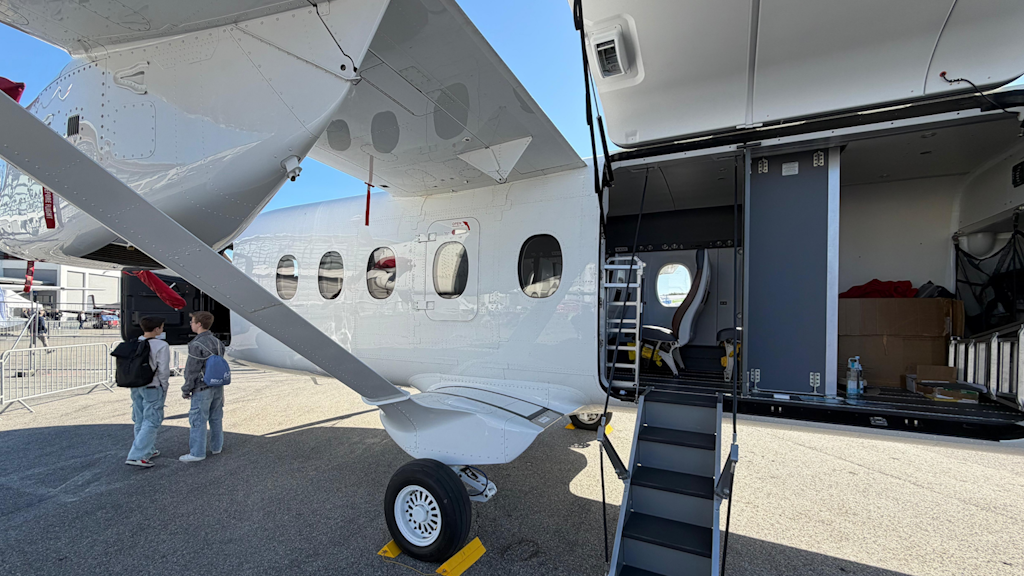
Among the notable premieres were the Cessna Citation Ascend, which Textron Aviation displayed for the first time at an air show outside the United States, and the Cessna SkyCourier, which made its first appearance at a European air show. Daher presented its TBM 980 and Kodiak 900 turboprop aircraft at a show outside the United States for the first time, while the B-100C by Kaelin Aerospace Technologies and the Terrone ultralight aircraft by Italy’s Promecc Aerospace made their world premieres. Cirrus Aircraft displayed the latest versions of its successful SR Series, as well as the SF50 Vision Jet personal jet. All of these aircraft are now equipped with Garmin’s Emergency Autoland system, which can automatically land the aircraft at the nearest suitable airport in an emergency.
AERO is not only a showcase of the present, but also a glimpse of what aviation may yet become. Sustainable aviation projects were particularly prominent in Hall A7, including fully electric and hybrid aircraft, hydrogen propulsion systems and solutions for developing energy infrastructure at airports. Projects presented on the new Innovation Stage demonstrated that the future of general aviation is already taking shape—quieter, cleaner and more technologically accessible than before.
As expected, the event also resulted in concrete business deals. Hamburg-based company Luminair announced an order for nine Cessna Citation Latitude business jets during AERO Media Day, while Tecnam presented several orders for training aircraft from various flight schools during the show. According to the organisers, other manufacturers also reported aircraft sales and appointments arranged for demonstration flights.
We were particularly pleased to hear Croatian being spoken at one of the stands—the one operated by Rijeka Airport. This was not Rijeka Airport’s first appearance at AERO, and its participation follows the example set primarily by German airports, as well as airports from neighbouring countries, which attend the show to present themselves to general aviation pilots. Another familiar exhibitor was Portorož Airport, which also introduced itself to an audience for whom smaller airports and general aviation destinations are highly relevant and attractive subjects.
A proper visit to AERO requires sufficient time. Simply walking through the halls is not enough, as the outdoor static display is equally worth exploring. Those attending for several days should also plan to stay until Saturday, when the traditional airshow is held on the final day of the event. Unfortunately, we had to miss that part because we visited Friedrichshafen only on Friday this year.
We also recommend that every AERO visitor set aside at least half a day to visit the Dornier Museum, located next to the passenger terminal at Bodensee Airport. It is easily reached by taking the shuttle bus from the exhibition grounds to the passenger terminal, followed by only a few minutes of easy walking. The museum is large, highly interactive and extremely interesting. It presents not only the history of the former German aviation giant Dornier, but also the broader development of German aviation.


AERO Career Days, held on Friday and Saturday, served as an additional reminder that the future of aviation depends not only on new technologies, but also on people. Young people interested in pursuing a career in aviation had the opportunity to meet potential employers, attend presentations and gain a better understanding of the opportunities emerging in an industry that is changing rapidly, yet still relies on knowledge, experience and passion.
Next year, AERO will expand even further on the global stage. The event will return to Friedrichshafen from April 14 to 17, 2027, followed by AERO South Africa in June, AERO Asia from November 11 to 14 in Zhuhai, China, and AERO Middle East from December 7 to 11 in Riyadh.
This was not the author’s first visit to AERO, yet the same conclusion returns every year: one day is simply not enough to experience this event properly. During those few days, Friedrichshafen is not merely a place where aircraft are displayed. It becomes a place where general aviation serves as a common language for everyone moving through its halls, corridors, courtyards and static display areas with the same sense of curiosity. And that is precisely why visitors almost always leave the show with the same thought: next time, they should stay longer.


![[SURVEY] Where would you like to fly with Croatia Airlines in summer 2027?](https://i0.wp.com/avioradar.net/wp-content/uploads/2026/10/CTN_A220-300_9ACAL_c_AvioRadar.jpg?fit=900%2C506&ssl=1)
