


The return of humans to the Moon has once again become a reality, as the world stands on the brink of the first such mission in more than half a century. The Artemis program marks the beginning of a new era, where the goal is no longer just a symbolic landing, but a long-term human presence beyond Earth.
Everything begins with the Artemis II mission, the first crewed flight within the program and the first human journey toward the Moon since 1972. The launch is scheduled for Wednesday, April 1 at 8:24 EDT (22:24 UTC), which corresponds to 00:24 Croatian time in the early hours of Thursday, April 2.
A return to a familiar trajectory
The key to understanding this mission lies in history. Before humans first landed on the Moon, NASA sent the Apollo 8 mission in 1968, during which astronauts orbited the Moon for the first time without landing. The same concept is being used today, as Artemis II will fly around the Moon without landing, testing systems and preparing the ground for future missions. In other words, it is a modern version of Apollo 8.
The difference lies in the details and ambition. While Apollo 8 lasted approximately six days, Artemis II will last around ten days, clearly demonstrating how today’s missions are more complex, longer, and technologically demanding. A broader scope of testing, more advanced systems, and wider objectives require more time in space. Just a few months after Apollo 8 came Apollo 11, when on July 20, 1969, Neil Armstrong became the first human to walk on the Moon. The Apollo program ended in 1972 with Apollo 17, after which humans remained confined to low Earth orbit for more than 50 years.
A crew opening a new chapter
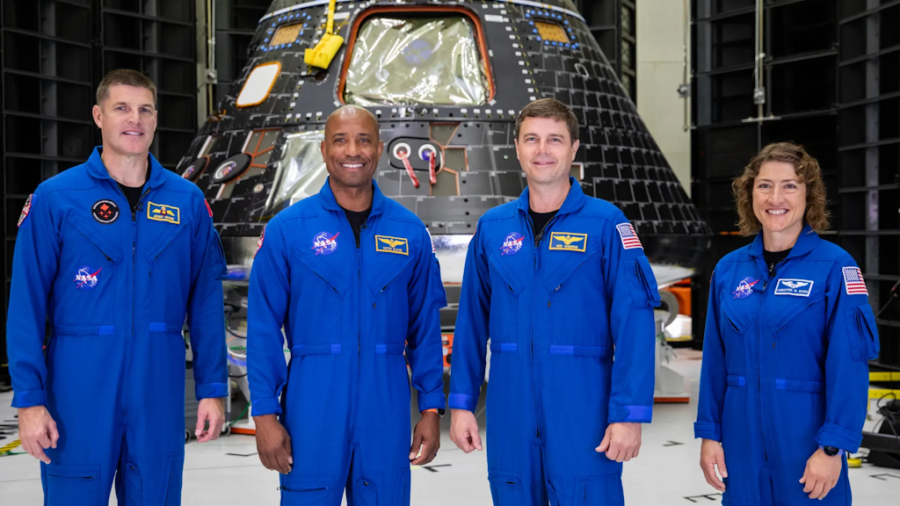
The mission will last about ten days, during which four astronauts will fly around the Moon and return to Earth. The crew is led by Reid Wiseman, a former naval aviator and test pilot who has already spent six months aboard the International Space Station. As commander, he will make critical real-time decisions and coordinate the crew during the most demanding phases of the mission.
Serving as pilot is Victor Glover, also a former naval aviator and veteran of spaceflight. During the Crew-1 mission, he spent nearly half a year in orbit, and will now leave Earth orbit for the first time to enter deep space. His experience in spacecraft operations and systems is essential for mission safety.
Mission specialist Christina Koch is an engineer and physicist who holds the record for the longest single spaceflight by a woman, at 328 days. Her technical expertise and experience working in extreme conditions make her one of the key members of the crew, particularly in system testing during flight.
The fourth crew member is Jeremy Hansen from the Canadian Space Agency, a former fighter pilot and physicist. Although he has not yet flown in space, he has spent years involved in astronaut training and the development of operational procedures. His participation further highlights the international nature of the mission.
Orion and SLS, the systems enabling the return
This new era of exploration would not be possible without new technology. At the heart of the mission are the Orion spacecraft and the Space Launch System rocket.
Orion is NASA’s newest spacecraft designed for humans, built for deep space missions. It can carry four astronauts and support them for up to 21 days without docking with another spacecraft. The capsule builds on more than 60 years of experience but incorporates entirely new systems for life support, navigation, and protection against extreme conditions.
Particularly important is its heat shield, the largest of its kind ever built, about five meters in diameter, designed to withstand reentry temperatures of up to 2,700 degrees Celsius. During reentry, the capsule enters the atmosphere at around 40,000 kilometers per hour, after which the parachute system slows it down for a safe ocean landing.
Beneath the capsule is the European Service Module, developed in cooperation with the European Space Agency, providing propulsion, power, water, and oxygen. It is this module that enables Orion to travel around the Moon and return to Earth.
The entire system is carried into orbit by the Space Launch System, currently the most powerful operational rocket in the world. It is a so-called super heavy-lift rocket, capable of sending both crew and cargo toward the Moon in a single launch. SLS combines proven Space Shuttle technologies with new systems, achieving an exceptional level of reliability.
The countdown has already begun
The countdown for launch has already started at Kennedy Space Center. Engineering teams are activating systems, checking communications, and preparing cryogenic tanks for fueling.
This is an extremely complex process. The rocket is fueled with supercooled liquid hydrogen and oxygen, while at the same time the sound suppression system is prepared, releasing massive amounts of water at liftoff to protect the structure.
The astronauts are in quarantine, undergoing final medical and technical checks. Everything is focused on a single goal, perfect readiness for launch. Current forecasts indicate about an 80 percent probability of favorable weather conditions.
More than just another mission
Unlike the Apollo program, where the goal was to demonstrate technological supremacy, Artemis has a long-term vision. The plan is to establish a sustained human presence on the Moon, develop infrastructure, and use the lunar environment as a testing ground for future missions to Mars.
A lunar landing is expected later in the program, no earlier than the Artemis IV mission, but Artemis II is a crucial step without which further plans have no foundation.
A return that changes perspective
Nearly 60 years after Neil Armstrong left the first footprint on the lunar surface, humanity is once again heading toward the same destination.
But this time, the perspective is different. Apollo was a race, a demonstration, a moment that was brief yet echoed for decades. Artemis is something else entirely—a slower, more complex, long-term return.
This time, as a species, we are not returning to the Moon to conquer it, but to understand it, to work there, and perhaps even to stay.
And for the first time in history, the Moon is no longer the end of the journey, but a new beginning.


